Sunday, November 2, 2014

OSBA GENERAL MEETING

OSBA General Meeting
Monday, November 10, 2014
Time: 1:00 to 3:30

Please join us on Monday afternoon for our meeting, guest lecture and social get-together at the Nepean Visual Arts Centre – Located at the Nepean Sportsplex.
The address is 1701 Woodroffe Avenue.  The NVAC is located at the back at entrance 3. (For those who have taken classes with Kerri – the meeting is in the same room.)

MEMBERHIP RENEWAL
It is time to renew your membership.  Please bring your cheque book or cash to the meeting.  Membership fee is $25 annually. If you wish to renew but are unable to attend the meeting please contact Sue Quinn at suequinn260@yahoo.ca 
NEW MEMBERS WELCOMED
NOMINATIONS AND VOTING FOR EXECUTIVE POSITIONS
Current members who are interested any positions can put their names forward to Jan Salmon at jansalmon@sympatico.ca  before the next meeting.  Also, anyone interested in nominating someone else for a position should send Jan those names as well.  

PRESENTATION
Horizon [intermittent] Horizon by Doris Lamontagne.
Images invite you to 'a walk by the water'. It provides an opportunity for reflection
and the need to get off the grid. No cell phone, no computer, and no electronics: achieving the state of flow where time and surroundings converge to a state of contemplation. A simple walk by the water is all that is needed…

Doris Lamontagne’s bio:
Whether as a photographer, an independent artist or a visual and interaction designer she has been involved in art-making all her life. Born in Québec, she lived in many different Canadian cities and in the USA; she made Ottawa-Gatineau her home in 1996. Trained in traditional film photography, she was an early adopter of digital photography. Her work in digital art and photography is shown regularly in art galleries and artists run centres. 

Tuesday, October 7, 2014

USING PHOTO REFERENCE IN BOTANICAL ART

by Celia Godkin

Botanical artists usually prefer to work from live specimens, but sometimes this isn’t possible, and we must turn to photographic reference instead. As a children’s book illustrator, I have to rely on extensive reference material from a variety of sources including photographs.

In my most recent book, Skydiver, there’s an oil painting of corn plants on a page that describes the spraying of farm crops with DDT. This was the pesticide that caused severe declines in peregrine falcons, the subject of the book.

The image was based on a couple of reference photos I took at the edge of a field of corn.  Knowing that the image would have to be a low view, looking upward towards an air-borne peregrine, I deliberately angled the camera upwards so that there would be lots of sky in the photos. 

Here are my reference photos: 


And here is a detail of the resulting illustration:


Note that I haven’t slavishly copied the photographs. To do so would mean that all the cast shadow and transparency that confuses the interpretation of form would have been included. Instead, I use the photographic reference as the point of departure, simplifying and eliminating confusing shadows to explain the form without violating the integrity of the plant structure.

Far from being a distortion, I view this departure from photographic realism as an integral part of the “scientific accuracy” component of botanical art. I seek to explain and clarify plant structures in the same way that science attempts to elucidate nature.

I hope this example clarifies one of the important differences between botanical art and floral fine art. Art imitates nature, science seeks to explain it and botanical art hopes to achieve both of these goals.

Book details:
Skydiver: Saving the Fastest Bird in the World by Celia Godkin; Pajama Press, 2014, is the inspiring story of how the peregrine falcon was saved from the brink of disaster. ISBN 978-1-927485-61-3 (bound) $19.95See further information at www.pajamapress.ca

Wednesday, October 1, 2014

OSBA SKETCHING GROUP – 2014


When the weather in Ottawa finally warms up, eager members of OSBA group have been gathering for a few hours each week to socialize with other members, to sketch outdoors in relaxed surrounding and be entertained by the numerous little animals and birds.
 
The outdoor sketching group has had it challenges this year.  Compared to last year where we were able to have our outings, pretty much, every week and going until mid-October.  This year, though, we had been haunted by the rain gods who seem to have been soaking up just about every Wednesday and Thursday all summer.  With that being said, Inga Legere, the Sketching Co-ordinator and part-time weather reporter, did managed to put together a handful of sketching get-togethers. 

We would like to thank volunteer Isabelle Nicol, Backyard Garden Manager, at the Fletcher Wildlife Garden for making us feel right at home in the backyard garden.


We also managed to get a few sketching days in at the Ornamental Gardens at the Experimental Farm.


Thursday, September 4, 2014

OSBA General Meeting - Monday, September 8, 2014

OSBA General Meeting
Monday, September 8, 2014
Time: 1:00 to 3:30


Please join us on Monday afternoon for our meeting, guest lecture and social get-together at Artistic Landscaping.

Bring your latest art work for display to your colleagues.

Presentation

"80 Years of watercolour painting" by Robert Anderson

Memberships

New members welcome! Sign up at our meeting. $25 member fee annually. 

Location

The Ginkgo room at Artistic Landscaping at 2079 Bank Place,Ottawa ON
Situated just off Bank Street across from South Keys Shopping Centre.

Wednesday, September 3, 2014

OSBA FALL ART EXHIBITION

BOTANICA 2014 FALL SHOW

The Ottawa Society of Botanical Artists has a 
NEW fall art Exhibition
at Artistic Landscape Design's BOUTIQUE GALLERY.

  Come check us out.


Situated just off Bank Street at 2079 Bank Place across from South Keys Shopping Centre


Artistic Landscape Design, Boutique Gallery, Ottawa
For avid gardeners, Artistic Landscape Design is the place to go for rare and unusual plants.


Artistic Landscape Design’s 
Boutique & Art Gallery are open until December 23rd.

www.artisticlandscape.on.ca
613-733-8221 Ext. 4

Saturday, May 24, 2014

OSBA Spring and Summer Exhibition

BOTANICA 2014

Check out the NEW Boutique Gallery at Artistic Landscape Design where the latest botanical art exhibition by OSBA artists 
is now on display.  


Situated just off Bank Street at 2079 Bank Place across from South Keys Shopping Centre, see paintings celebrating the wonderful colours of the spring and summer seasons.  Watch for new work coming later in the fall.


Artistic Landscape Design’s Boutique & Art Gallery are open until December.
Monday to Saturday 9 am to 6 pm
Sunday 10 am to 4 pm
www.artisticlandscape.on.ca
2079 Bank Place, Ottawa


Artistic Landscape Design, Boutique Gallery, Ottawa
For avid gardeners, Artistic Landscape Design is the place to go for rare and unusual plants.


Write up submitted by Jan Salmon

Sunday, April 13, 2014

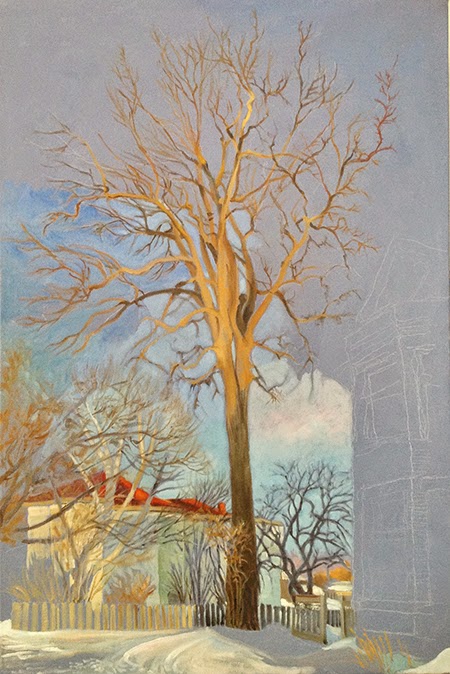
Painting a tree - the ancient Rock Elm in Merrickville (oil, 36 x 24 in.) by Aleta Karstad


I have just finished the biggest oil painting I have ever done - a commissioned portrait of the largest Rock Elm on record, which lives in the nearby village of Merrickville. In order to capture the relationship of the towering tree and the old red brick mansion, I stood in the front yard and looked up. I took several photos, three of which would be joined for the composite view which I used as reference in the studio. I then sat nearby, writing a journal account of the time and place until dusk. You can read my journal notes at http://www.aletakarstad.com, after the piece that Owen Clarkin (who commissioned the painting) wrote for me on Rock Elms.  

Rock Elms are characterized by thick corky wings of bark on the twigs. The main trunks of the Merrickville tree fork with proper acute angles at regular intervals, setting the dominant rhythm of the tree in an elegant, symmetrical shape - but within the shape of this tree, medium sized branches elbow dramatically at all angles, expressing their individuality, like surprise passages in a symphony by Beethoven. 

I began with a violet-gray underpainting on the 36 x 24 inch stretched canvas, and scratched the lines of tree and house into the wet paint. The tree trunk and main branches were painted onto the fresh underpainting, and next, quickly, came the neighbouring house and fence with trees and bushes, softly blending against the lower sky. I use water mixable oil paint, which dries a little faster than regular oils. I like to add new colours directly into fresh paint, "al fresco" for a soft, integrated look. If I work onto dried paint, the edges tend to be harder, and often require further strokes of the underlying colour to soften them. 


You can see the steps as I developed the painting. Since it was large, I painted the sky in sections with the smaller twigs against it, so that the paint of the sky would still be wet for blending the twigs into - especially the most distant twigs. In the larger image of the finished painting you can see the pale wispiness I painted on the sky between and among the twigs, This was a solution to the problem of how to get the crown to look full of twigs without painting every tiny twig of the many thousands (that would have reduced the brightness and made it look cluttered and fussy). The halo of ghosty twig impressions whiskered into the sky spaces in paler blue was a successful experiment - it filled out the back of the crown to look more three-dimensional! 

I exaggerated the orange of sunlight on some of the twigs of the crown, in order to make a bit more colour contrast up there against the sky. When I do this sort of thing Fred and I call it "red worms" - a trick which we first noticed in the 1970s in a painting of a rushing whitewater river. I am careful to keep my trick at a minimum, so that it does not alter the perceived colour of the subject, but only increases the effect of liveliness and immediacy. Red and orange appear nearer to the viewer, and where the opposite colours of blue and orange lie against each other, they actually vibrate in our visual perception.

Bark texture was important to show, but not everywhere - because when you look at a tree, you don't look at all of the detail at one time. This is hard to explain, but it's part of what makes an oil painting different than a photograph. The painting flows from lights to darks and guides your eye like music on the canvas, understating some things and overstating others to produce the effect of actually being in the presence of the tree. 

At first I was worried that the building would compete too strongly with the tree, or that my angle on it would look strange and distracting, but the towering Rock Elm holds its own in its relationship with the house. It was fun finding reflections in the windows and changing the colours of paint on mulleins and frames according to sun and shadow. I don't paint many buildings, but I always enjoy it! The mansion, built in the late 1800's, adds a sense of "Heritage" to the painting for those who may not already be aware that this Rock Elm, being of a slow growing species, is certainly older than the building, perhaps even twice its age! Owen has a photo of the mansion taken in the 1920's, which shows that its companion tree was almost as large nearly 100 years ago as it is today!

This painting is the first of a series of Elm tree portraits commissioned by Owen, to raise public awareness of notable trees in eastern Ontario. Next will be a large and graceful Slippery Elm by the Ottawa River west of Aylmer, Quebec, and the third will be a huge American Elm in downtown Aylmer. He is also writing a book on the subject.